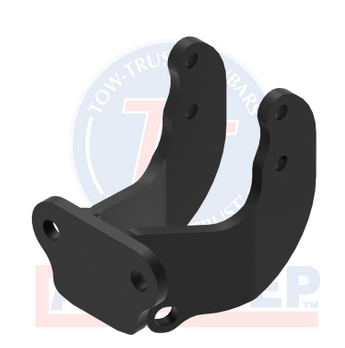
Fixed flange
A separate towball bolts to a flat mounting plate. The neck stays fitted when you are not towing.
Tell us about any accessories you want to use so we can check the suitable arrangement.

A little help choosing
Start with what you want to tow or carry. You don’t need to know the technical specification — tell us about your vehicle and we’ll help you choose.
01 / The towbar
The options depend on your exact vehicle. These are three common designs; not every design is available for every model.
A separate towball bolts to a flat mounting plate. The neck stays fitted when you are not towing.
Tell us about any accessories you want to use so we can check the suitable arrangement.
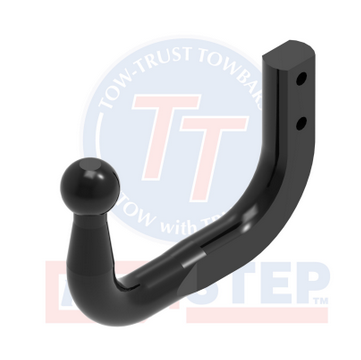
A curved neck incorporates the towball, giving a different appearance from a flange design. It stays in place when you are not towing.
A useful option to discuss if you want a fixed towbar.
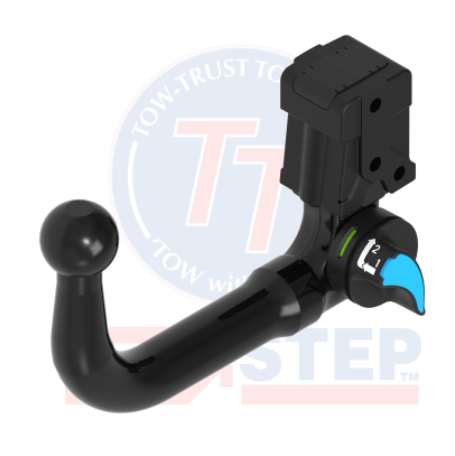
The neck and towball can be removed when not in use; the main towbar structure remains fitted.
How much remains visible depends on the vehicle and design. Follow the manufacturer’s fitting, locking and removal instructions.
Product images are examples from Tow-Trust. They do not show the exact towbar for your vehicle. Manufacturer information ↓
02 / The socket
Match the socket and its connected functions to your trailer, caravan or carrier — not just the number of pins on the plug.
7-pin electrics provide the usual trailer road-lighting functions. They are often used with simple trailers and some bike carriers.
They do not provide caravan battery charging or a reversing-light connection.
13-pin electrics can support reversing lights and additional power connections, as well as road lighting. The actual functions depend on the wiring fitted.
Tell us which plug your caravan, trailer or carrier uses.
03 / Behind the socket
7-pin or 13-pin describes the socket. Vehicle-specific or universal describes the wiring kit connecting it to your vehicle.
Designed for a particular vehicle application, with matching connections and electronics. Depending on the vehicle and kit, it can support towing-related features such as parking-sensor changes or trailer recognition.
We check the exact application and supported functions.
A kit designed for use across a range of vehicles, rather than one exact application. It may provide suitable trailer lighting where compatible.
It is not suitable for every vehicle and should not be assumed to provide the same integration with the vehicle’s towing systems.
04 / Carrying bikes
Tell us the carrier model, the number of bikes and their weights — especially for electric bikes.
We need to check the vehicle’s permitted use, the towbar and towball, and the carrier’s fitting requirements.
The combined weight of the carrier and bikes must stay within the applicable vehicle, towbar and carrier limits. Each bike must also meet the carrier’s limits.
A towing-weight rating is not a bike-carrier load allowance. Follow the vehicle, towbar and carrier instructions.
We can help with the details
Your vehicle registration, fitting postcode and what you want to tow or carry are a good starting point. If you are unsure about any option, choose Please advise in the quote section.
Manufacturer guides: Tow-Trust — towbar types (online); ECS — 7-pin and 13-pin electrics (online); Westfalia — wiring kits (online); ECS — additional power feeds and coding (online); Thule — example carrier instructions (PDF) (online).
This is a general guide. The instructions and limits for your exact vehicle, towbar, wiring kit and accessory take priority.